
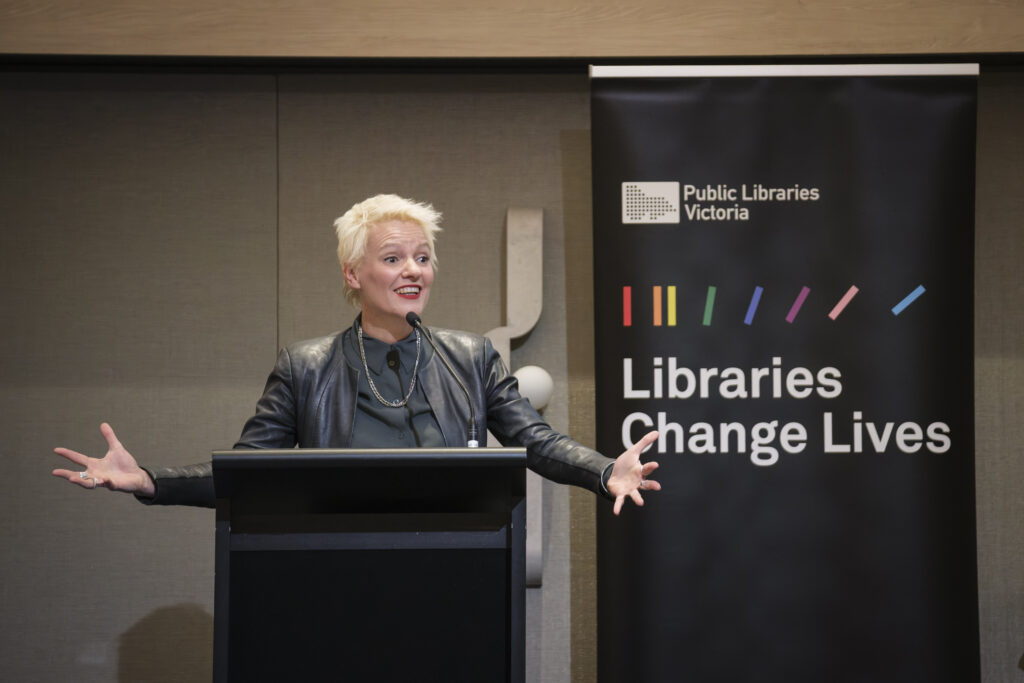
The following article by Jacinta Parsons is reprinted with the kind permission of the author; it originally appeared in The Spencer Street End. The featured image of Jacinta at the PLV conference is by Suzanne Phoenix.
This week I was the MC at the Public Libraries of Victoria conference. This is the second time I’ve hosted, so I should have been far more prepared for how much this conference was going to affect me. Libraries have transformed from the olden days when you were shooshed and sent overdue notices and responded to the changing landscape of a world that no longer finds time or value in holding a book in its hand. Of all our institutions, libraries have been the quiet achievers in the ‘pivot’. What could have reasonably been a refusal to move on from the revery of the pursuit of knowledge and reading, has become an international revolution.
My first library was in Box Hill.
Box Hill Library was a space that became increasingly important to me as a teenager in a daggy suburb. We weren’t taken to the library as young kids. It wasn’t the way my mum and dad were brought up. As soon as I could find my way to the library, by myself, it became my regular home.
There was something incredibly tactile about the library – those delicious date stamps that the librarians would roll numbers around to stamp the bits of paper that were glued in the back of the book 40 years ago. I realise it’s a hard economic argument to mount, due to the inefficiencies of stamping a book I guess, but it hurts in my stomach when I realise the whole ritual is gone.
Although recently, in a Paris library, the application to secure me a membership was done with paper and pen and stamps and a middle-aged librarian ensuring all the boxes were ticked and the induction thorough. I mourn for the children who won’t know the feeling of lining up and organising their books so that the librarians could go straight to the back to stamp it.
Those hallowed institutions that were once venerated, quiet and full of ideas, with books assembled within an inch of their Dewey Decimal life, are now places of refuge and connection and home. Listening to people speak about their work in libraries was shocking in that way that you can be shocked when you hear something so obvious and true, because you realise you haven’t heard it spoken like this for a really, really long time.
At the beginning and end and middle of every presentation, was a program, or a new idea or a philosophy that put people at the centre of its reasoning. Why would we do x, y or z – was answered in a range of different ways but basically, I heard over and over again the reason was always, ‘because it’s good for people.’
The people who are drawn to librarianship and, increasingly, to simply work in a library are maybe the best kind of people. They have chosen to work in the place that they might have found a home in when they were young. Or they just love books. Or they love the word ‘catalogue’ or making spreadsheets and they certainly have a shared love of lanyards covered in stickers with keys that hang from them. Fundamentally, the reason you work in a library seems to be just a love of the work that can happen in a library.
Which is perhaps what makes their work so authentic and so unique. What naturally follows this fervour, is a deep and abiding interest that everyone should also have the chance at finding that same love of being inside a library. Community refuge and care and the nurturing of this place of belonging is one of the most important secondary outcomes. But it’s secondary. The first consideration for library peeps is to provide a unique environment of discovery for everyone who might walk through its doors. And what is created as a result of that, is a rare and golden space for ‘everyone’.
While equitable access to free WIFI and a focus on the doors being open for people to come through as they are, are its heartbeat – the library works as a flat social structure where care is not contingent on you being an ‘other’. Instead, care is for all. I felt this years ago when my local library had their regular weekly community lunch. I was at the library writing and was hungry and could smell the food from a floor above. I thought ‘community lunch’ was code for those in the community who could not afford lunch, but instead it was simpler – it was a lunch for the community, and because I was part of the community – I was invited.
What happened at that lunch was nothing short of transformative for me. I could see the immense value in those that could and those that could not, sitting around a table together as we clambered for the garlic bread and pasta. We sat as people who shared food and a geographic location – and then, of course, much more.
But this genuine community shoulder to shoulder, is a difficult thing to achieve without the self-consciousness that often accompanies acts of love and service. There is almost no other environment that this might occur in the way this can in a library – we enter the library for our own reasons – study, writing, warmth, chats, using the 3D printer. The fundamental thing that connects us, is that we are sharing space. And it’s a space that invites us to feel a belonging for who we are, on that day, in whatever way we turn up.
As a writer, libraries have become the most essential space for ideas to transform and evolve. I travel the country and attend library events about my books. What I encounter is a local community that have turned up to their local library to share and push ideas. The utopian dream. It’s these sessions, even more than book festivals, that I get to hear the heart of ideas and challenge my own. The most recent was at Kingsville Library where a small community turned up, and we spoke about our lives with such intimacy and truth that it has been difficult to shake.
If we can do one thing to push back against the corporate neo liberal anti human machine, or as Kim Gordon once put it, against, the male white corporate aggression is to visit our libraries. And champion them. And participate in them. And thank our librarians for being some of the last, remaining idealists who believe that where lanyards and stamps and a whole lot of toilet rolls made into an obscure piece of art, can actually change the world.
Libraries change lives.